
Neighborhood associations are vital to Community Builders of Kansas City’s stakeholders. Beyond fostering a strong sense of community, they advocate for better housing, reduced crime and economic opportunity. This article is the second of a two-part series featuring just a few of the many important and innovative works of Key Coalition and Oak Park neighborhood associations.
Housing is Key for Key Coalition
Karen Slaughter was elected to a one-year temporary term as president of Key Coalition Neighborhood Association in 2009. Fourteen years later she is still there. Slaughter and the coalition advocate for the area from 27th to 35th streets and Prospect to Woodland. As with other East Side neighborhood associations, Key Coalition has identified the need for affordable housing as a top priority. The organization has been able to collaborate with partners to offer several innovative housing options.
“We worked with the city of Kansas City, Missouri, to develop a prototype of affordable housing that, while being a new build, matches the original shirtwaist architectural style of the homes in the neighborhood,” said Slaughter. “It was important to us that the new homes blend in with the existing housing. The homes are also unique in that most affordable housing are multi-family rentals and these are single-family, owned homes.”
Key Coalition came up with an idea for townhomes across the street from the Kansas City Missouri Police East Patrol Campus at 27th St. and Prospect Avenue and was able to secure a partnership with the city to bring it to fruition. There are currently four townhomes built that are owned instead of rented which is important for maintaining property value. Slaughter said there are an additional four townhomes planned for 27th St. and Brooklyn Avenue. Additionally, they are working with another developer to build housing behind the Kansas City Public Library at 30th St. and Prospect Avenue.
Key Coalition has been able to engage community partners on non-housing initiatives, including its long-standing relationship with Kansas City Public Library. The group supported the 2009 $1.3 million renovation of the Lucile H. Bluford Branch of the Kansas City Public Library at 3050 Prospect Ave. and supports the location’s current expansion.
“Our partnership allows us to be involved in ensuring good programming at the library,” shared Slaughter. “Library staff are more knowledgeable about its patrons’ needs but they engage us to share what our neighbors want. We’re also enlisting our residents to provide input on how the expansion space should be utilized.”
Key Coalition partnered with Kansas City Parks and Recreation planners to add $1.2 million in amenities to Spring Valley Park, located at E. 28th St. and Spring Valley Drive, and secured funding through the city’s Public Improvements Advisory Committee. Additionally, when home values started rising, threatening to push out some of the existing homeowners, the group completed an urban renewal plan that provided homeowners a 10-year tax abatement for completing $5,000 worth of home improvements.
Oak Park Seeks Partners for Initiatives
When Forest Tyson, Jr., vice president of Oak Park Neighborhood Association, speaks about his residents, you can hear the passion in his voice.
“We need new affordable housing that won’t gentrify the neighborhood; that’s our main focus right now,” he said. “And what our neighbors can afford is $700-$800 a month, not the $1,600 monthly rent that the state defines as affordable.”
Tyson, who was born and raised in the area that spans from 31st Street to Emanuel Cleaver II Blvd. and from Prospect Ave. to Jackson Ave., has coached basketball there for 20 years and has been with the association for 10 years. He explains that there are no new housing options that are affordable in the Oak Park area. Most of the homes are 70 years old, so renovating to make the structures livable is cost-prohibitive for most residents, a combination of renters and fixed-income elderly.
Tyson explained that to fix the problem, the association needs an infusion of up-front capital to rehab the older homes or build new ones, which has been difficult to attain.
“When you ask for funding, the city (city of Kansas City, Missouri) is good with reimbursable grants, but we don’t have the money to spend up front,” he said. “Plus, grants are hard to apply for and we don’t have the staff or time to complete the paperwork, jump through procedural hoops and deal with the politics involved.”
Tyson said that without government assistance, they are turning to assistance from the private sector. “We’re looking for partners,” he said. “We have access to contractors, rehabbers, electricians, plumbers and other laborers, but not the money to pay them.”
Unlike the Key Coalition, that has been able to leverage the catalytic investment made by the police and library, Oak Park sits in an area that has not had the benefit of major outside investment.
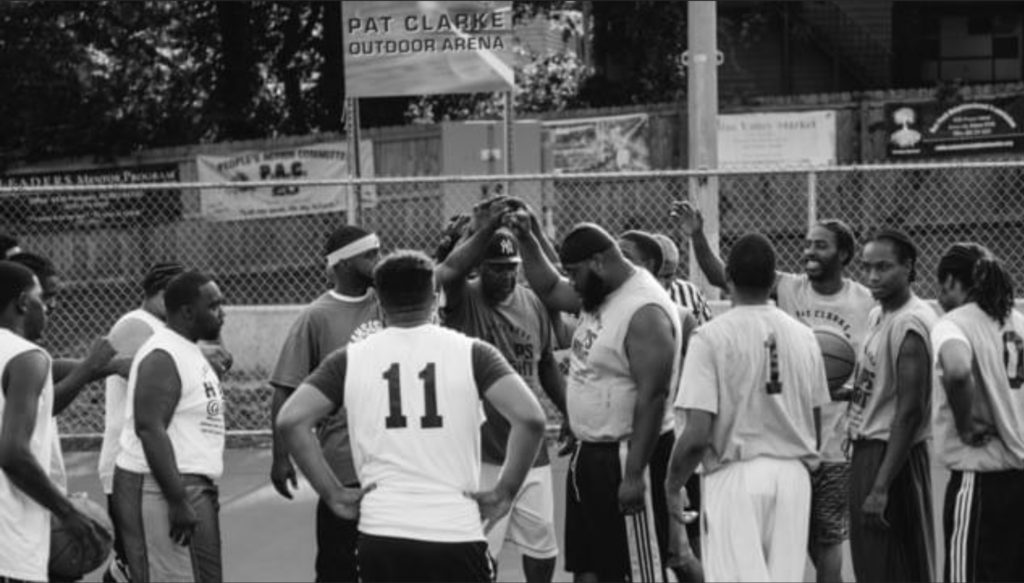
Tyson said that in addition to affordable housing, another top priority for Oak Park is crime prevention. Pat Clarke, association president, created Hoops at Night, a basketball league that plays under the lights at the Oak Park basketball courts throughout the summer. This year marks the eighth year of the program. Clarke has a long-term vision of building an entertainment center with a bowling alley, water park and other things for kids to do as well.
“We have to keep the kids busy in order to deter crime,” said Tyson. “We are asking the Kansas City Public School District to allow kids to use the vacant gym space in the summer to play basketball and other sports.”
In the past, the Kansas City Police Department dedicated four officers who met weekly with Oak Park Neighborhood Association leadership, who shared what they had heard from their contacts about potential crime. The officers then personally met with the parties involved to ward off crime. Tyson said it worked and they hope to work with the department in a similar way again.
Third on Oak Park’s agenda is keeping the neighborhood clean and free of trash dumping. Tyson said they partner with city administration on a program called Engineering Neighborhood Jobs and Opportunities for Youth (ENJOY). The city pitches in a stipend that the association uses to pay people for picking up trash.
“We continue to search for partnerships with the city, churches, school or community, to bring players to the table and find creative ways to address the housing, crime and dumping that plague our neighborhoods,” Tyson said.