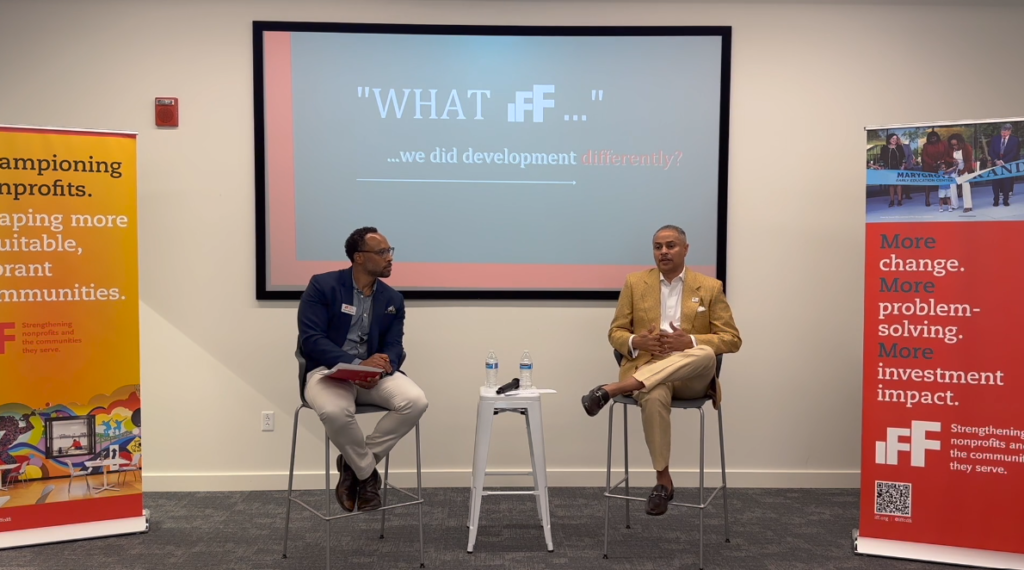
On Thursday, June 15, Community Builders of Kansas City President and CEO Emmet Pierson joined IFF Executive Director for the Southern Region Stephen Westbrooks at Junior Achievement of Greater Kansas City for a conversation about what community development can look like in Kansas City.
At “What IFF… we did development differently in Kansas City?” Pierson talked about the obstacles to developing in under-resourced areas and ideas for improving community development.
The conversation began with Pierson being asked how he defines community development.
“To me, community development is building assets to support a community,” he said. “There’s a tendency to boil that down to affordable housing but at CBKC, it’s about meeting the needs for all goods and services. For example, a community needs mixed-income housing to bring in more taxes and commercial space for burgeoning entrepreneurs. It needs cultural assets to educate residents and education and assistance navigating city hall and charities, just to name a few.”
Next Pierson was asked for suggestions and solutions on how to do community development in Kansas City differently.
“We need to support nonprofit developers and Black and brown developers and contractors and look at how resources are deployed,” he said. “Banks are still using appraisal-based underwriting. If you’re trying to reinvest in underserved and under-resourced areas, there’s an inherent conflict between the cost to do it and the value it will generate. So a developer ends up putting in its own money up front, which takes money away from not just that project, but future projects as well.”
Pierson gave the example of CBKC’s The Rochester residential development, saying the project was done as a proof-of-concept, to help banks begin to consider a different approach to lending. He complimented IFF on its non-appraisal-based lending approach.
Another obstacle to community development according to Pierson is local government and philanthropic participation.
“Other more progressive cities will dip into their general fund, whereas Kansas City tends to rely on federal money for urban development,” he said. “City and state government should be leading community development. We also need local philanthropists to be more engaged with brick and mortar development. Sunderland is doing a great job of committing to the cause but other foundations in town and it’d be great to see other foundations follow their lead.”
He named the Ford Foundation as an example of a philanthropic organization that goes into its corpus (original assets) to support address needs.
In addition, Pierson noted the need for additional minority-owned large contractors.
“In Kansas City, it’s the same contractors on all the large jobs,” he said. “We need to support and grow minority contractors. One way to do that is to eliminate a big barrier to entry – the cost of bonding. We could set up a pool to fund a true bonding program for construction companies run by people of color.”
Additionally, Pierson observed that smaller minority contractors should be willing to partner with larger contractors that can take on more of the debt, referencing CBKC’s partnership with Edgemoor.
“Edgemoor has been a great partner for us,” said Pierson. “They have a culture of seeking out partners of color.”
Cultivating the next generation is another way to improve community development according to Pierson.
“In the past, Kansas City urban development was led by dynamic titans of industry and dominated by non-profits,” he said. “About 17 local community development corporations were organizing and developing housing and the city was building single, for-sale housing. Today there are only four nonprofits doing this type of work and they all have older CEOs and a thin bench with no succession plan.”
Pierson also talked about the need to expand circles and rethink how we engage with each other.
“We can’t do development differently if we stay in our silos,” he said. “If I work and live on the East Side, I’m not going to have the opportunity to know who to approach at a major downtown bank or how to talk to local business leaders about what I do. We need to expand our circles of conversations, get out of our comfort zone and have the difficult conversations.”
The tendency to over plan and under implement is another barrier to good urban development in Kansas City, Pierson said.
When asked what makes him hopeful for the future, Pierson cited banks beginning to entertain conversations about non-appraisal-based lending, Kansas City’s Affordable Housing Trust Fund (city-wide fund to promote, preserve and create long-term affordable housing for extremely low-, very low- and moderate-income households), local charities starting to consider place-based investment, the recent improvements at Kansas City Public Schools and the optimism of the younger generation.
To watch the complete conversation, visit https://vimeo.com/838044744.
1 According to GivingCompass.org, the “payout rule” refers to the fact that, by law, private nonoperating foundations must distribute five percent of the value of their net investment assets annually in the form of grants or eligible administrative expenses, with certain exceptions. The rule was created to prevent foundations from receiving assets but never actually making charitable distributions with them.