
By Emmet Pierson, Jr.
The coronavirus pandemic exposed extreme disparities in housing options and availability for our working class and disadvantaged populations. In many neighborhoods across the country, lack of access to quality housing is an unofficial “state of emergency” with no clear direction of how to address the problem.
Good housing options are not available at a price point that an increasing number of individuals and families can afford while having enough money remaining to meet their basic needs or create savings. A a majority of these households live paycheck-to-paycheck and are just one setback or unexpected expense away from being unable to pay their rent or mortgage.
A Joint Center for Housing Studies of Harvard University, “America’s Rental Housing 2020,” reports that one in four renters spent more than half of their incomes on housing in 2018.1
To meet the 30-percent-of-income affordability standard, a household earning $30,000 a year would have to pay no more than $750 a month for housing costs, while a household earning $45,000 would have to pay no more than $1,125. As the stock of units charging such low rents continues to decline, it is increasingly difficult for households with modest incomes to find housing that is within their means. JCHS of Harvard University, America’s Rental Housing 2020
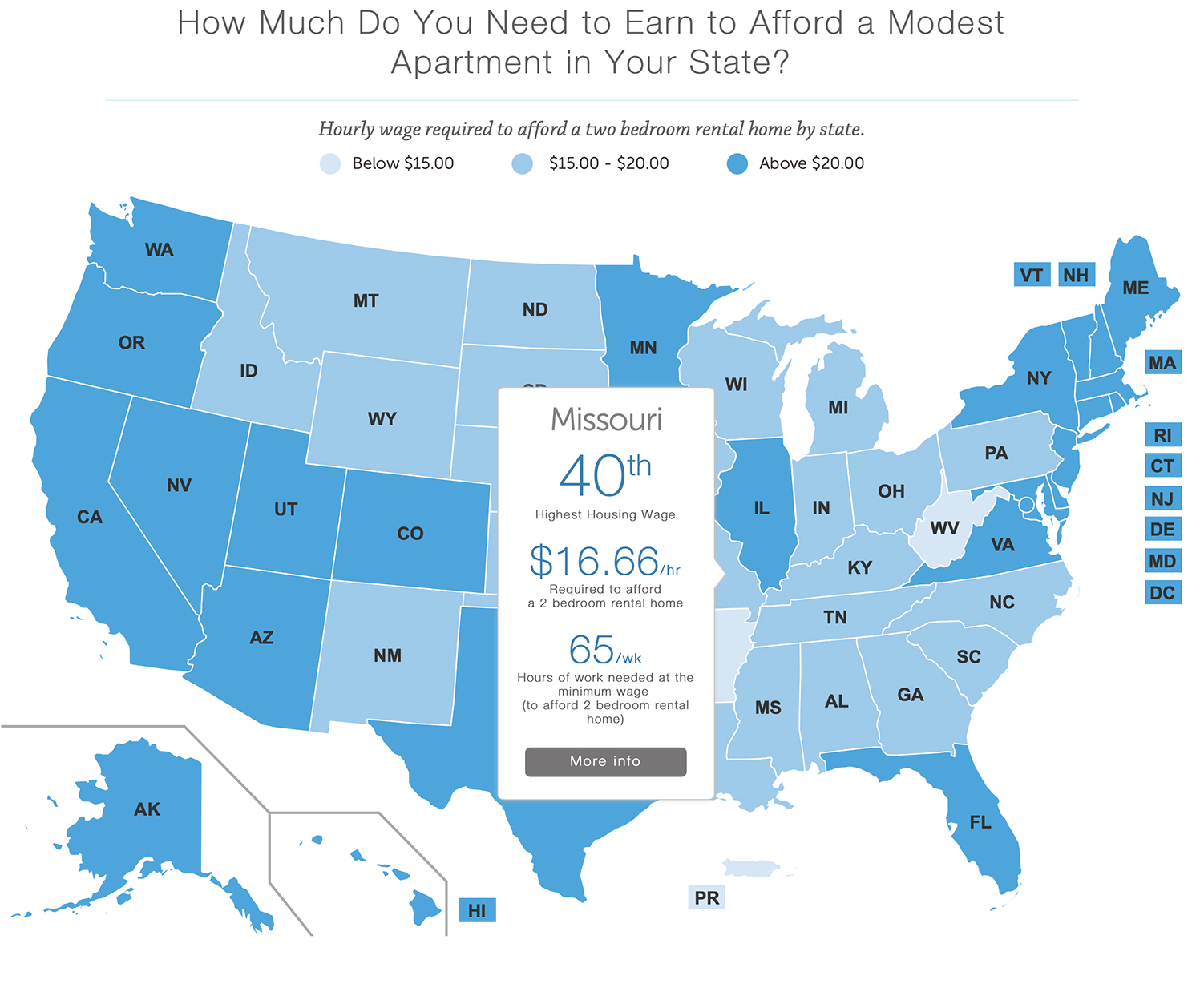
Millions more live in a state of housing uncertainty, described as living with a friend or family member, experiencing frequent moves, having trouble paying rent or being without consistent employment. A full-time Kansas City-area employee making Missouri’s 2021 minimum-wage of $10.30 per hour does not have a high enough income to afford a market-priced, two-bedroom home in any county of the metro.
That is according to the National Low Income Housing Coalition’s “Out of Reach: The High Cost of Housing 2021” report issued in July that shows the hourly wage would have to be $16.66 per hour to afford a two-bedroom rental home or, the employee would have to work a 65-hour work week at the current minimum wage to afford the same home.2
National Low Income Housing Coalition, Out of Reach: The High Cost of Housing 2021
While solutions at the federal level go wanting, some progress has been made locally to address the challenge of access to quality housing for Kansas City-area, lower- and middle-income individuals and families.
In 2017, Kansas City, Missouri, voters passed the Central City Economic Development (CCED) sales tax, which imposes a 1/8th percent sales tax to fund economic development projects in Kansas City’s urban core, which has experienced disinvestment and redlining for decades. In each of its annual rounds of funding, CCED-derived revenue has spurred the rehabilitation or addition of affordable housing choice in our urban residential neighborhoods including single-family and cottage-style homes, apartments, townhomes, assisted living, senior living and homes accommodating the disabled.
Within CBKC there has always been a strong focus on quality, affordable housing. Since our beginning in 1991, we have leveraged our role as a strong, stable and experienced community development corporation to add more than 750 housing units, primarily apartments and townhomes, either through complete renovation of substandard housing or new construction.
Community Builders’ $225 million investment in urban renewal over the years has earned recognition and respect on the national community development stage. We take seriously our responsibility in economic development access and advocacy for Kansas City’s east side and see that there is no better time than now to partner-up and scale-up.
1 Joint Center for Housing Studies of Harvard University https://www.jchs.harvard.edu/americas-rental-housing-2020
2 NLIHC Out of Reach 2021: Missouri https://reports.nlihc.org/oor/missouri