Latest News
Financing the East Side along Brush Creek, One Puzzle Piece at a Time
You’ve heard the saying “it takes money to make money.” It’s true. For all the good that Community Builders of Kansas City is doing and wants to continue doing into the future, it needs resources, and funding for projects on Kansas City’s East Side can be challenging.
“We have to get creative to attract funding; we have to bring together various pieces of the financial puzzle,” said Emmet Pierson, Jr., CBKC president and CEO. “Investing in our community may not yield enough return for some investors. We have to find other like-minded organizations that see the bigger picture and have a triple bottom line like us.”
To that end, CBKC has added powerhouse financial talent with years of experience specific to the intricacies of pulling together funding for difficult projects in the urban area and cultivated new funding streams throughout the country.
Steve Weatherford’s 40 years of housing policy and affordable housing finance knowledge and Bob Langenkamp’s experience at the City’s Economic Development Corporation and Planning and Development department help further equip the organization to seek new ways to fund projects and fundamentally shift the way it does business.
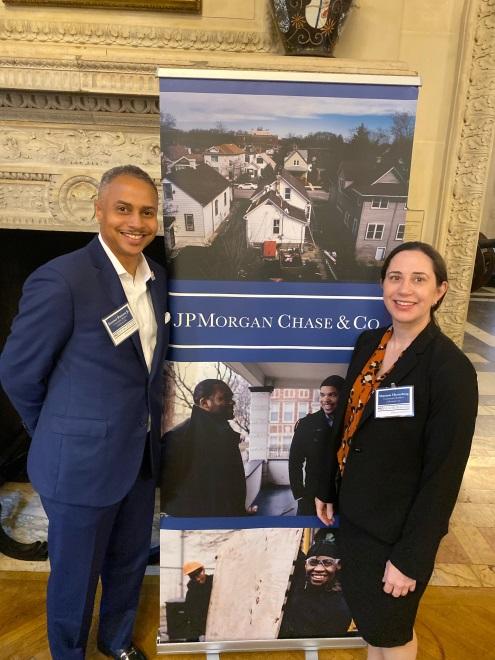
CBKC utilizes a variety of financing methods including conventional bank loans, HUD financing tools, local, regional and national grants and public/private partnerships. Grants like JPMorgan Chase’s Pro Neighborhood Grant, that has never been awarded in Kansas City, and public funds like the Kansas City Central City Economic Development fund and Opportunity Zones are just a few of the pieces of the puzzle.
Call To Action – HBCU Tour
March 29, – April 4, 2020, marks the 23rd annual HBCU (Historically Black Colleges and Universities) Tour for qualifying 10th – 12th grade Missouri and Kansas students. In 2018, the tour resulted in more than $300,000 in combined scholarships offered to seniors participating in the tour. CBKC is proud to be among the sponsors of this program.
Hosted by the Beta Lambda Educational Institute, the HBCU Tour takes up to 80 enrolled high school students on a week-long, whirlwind tour of nearly a dozen higher education institutions. The 2020 tour stops include:
- Kentucky State University, Frankfort, Kentucky
- James Madison University, Harrisonburg, Virginia
- Virginia Union University, Richmond, Virginia
- Norfolk State University, Norfolk, Virginia
- Hampton University, Hampton, Virginia
- University of Maryland Eastern-Shore, Princess Anne, Maryland
- Delaware State University, Dover, Delaware
- Bowie State University, Bowie, Maryland
- Howard University, Washington, D.C.
- Harris-Stowe State University, St. Louis, Missouri
Know a student that should be interested? Space reservation for the 2020 tour is underway now. Direct the student/family to the Alpha Phil Alpha Fraternity, Beta Lambda Chapter website for more information.
Want to help eligible students join the tour? Contact Don Maxwell at 816.421.2021 to learn how you can be a sponsor of the $500 per student cost which covers:
- Ground transportation
- Hotel accommodation
- Breakfast and lunch daily
- Guided tours
- Sightseeing tours
- On-site admission and scholarship applications
- ACT preparation
- College readiness clinic
Advocacy – Opportunity Zones
This fall brought a flurry of engagements where CBKC had the opportunity to represent East Side interests including a meeting with Congressman Emanuel Cleaver II and Federal Reserve Chairman Jerome Powell, to CBKC President and CEO Emmet Pierson, Jr., and Pedro Zamora, executive director of the Hispanic Economic Development Corporation (HEDC) co-leading the KC Shared Prosperity Partnership Forum to Pierson presenting as part of the panel at the Opportunity Zones Summit.
All of these opportunities related to issues of investment inclusivity. Being included in these discussions is one step. Being a leader in these discussions is another step. Bringing these discussions to fruitful investment in the urban core is the most important step.
On October 9, Pierson joined a few of his community development peers, bankers, community and civic leaders in a roundtable with Federal Reserve Chairman Jerome Powell. Hosted by Congressman Cleaver at the Federal Reserve Bank of Kansas City, the discussion centered on community development, local banking, employment, consumer goods pricing and challenges in the financial sector.
Kansas City’s Forum of the Shared Prosperity Partnership, a collaboration of The Kresge Foundation, the Brookings Metropolitan Policy Program, the Urban Institute and Living Cities, was hosted October 3 at Plexpod Westport. Focused on economic values and incentives, the discussion led by Pierson and Zamora was wide ranging in identifying shared values in housing, job opportunities, neighborhoods, transportation and more, as well as tools to evaluate resource allocation and economic mobility. Local partners of the Forum included the Civic Council, Mid-America Regional Council, KC Rising and the Chamber.
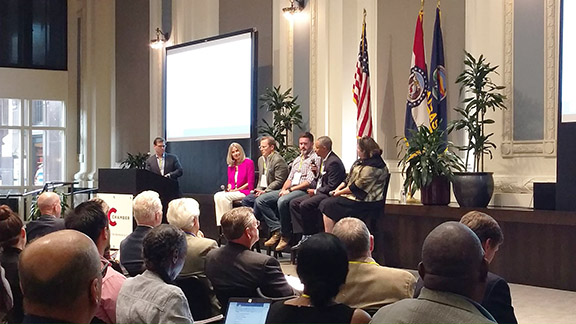
In September, the Kauffman Foundation sponsored an Opportunity Zone summit at the Chamber of Commerce. Pierson served as one of the panelists for the discussion and spoke to how a $100,000 loan to CBKC 27 years ago resulted in a financially sound organization with more than $80 million in assets inclusive of institutional development, market rate and affordable housing, office buildings and retail centers on the East Side. Pierson also narrated a bus tour of investors and other summit attendees of the Kansas City Opportunity Zones.
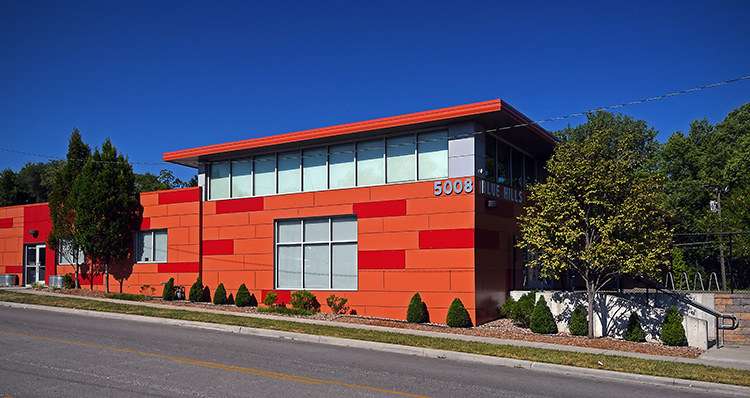
Development – Blue Parkway Offices at 100% Occupancy
CBKC’s success in community-based development is rooted in our model to build, own and manage over the long term. That model has well served properties both long held by the organization and more recent acquisitions.
By the second quarter of 2019, CBKC’s Blue Parkway office building achieved 100 percent occupancy. While Kansas City’s office market is strong, first quarter vacancy rates, according to Colliers International, were more than 8 percent. Built in 2003 with a $10.5 million investment by CBKC, the 69,000-square-foot building has become a community service hub.
CBKC has purposefully attracted a collection of like-minded organizations dedicated to serving the urban core. The newest tenant, Mid-America Assistance Coalition (MAAC) fits that model. An organization offering information systems, training and advocacy to residents and social services providers. MAAC signed a five-year lease for 3,000 square feet and moved into the new space on April 1. The space will house the organization’s LIHEAP (Low Income Home Energy Assistance Program) services while it maintains its headquarters location on Armour Boulevard.
The three-story, Class A building was constructed as the first speculative commercial office building in the area in more than 30 years. CBKC developed it a component of the award winning, massive Mt. Cleveland Initiative, a campus that now includes a 143,000-square-foot, federally qualified health center; more than 300,000 square feet of commercial, office and retail space including a full-service grocery; a daycare facility; affordable housing and other critical resources.
CBKC’s 5008 Prospect renovation was one of the first Central City Economic Development (CCED) one-eighth-cent sales tax-funded projects to complete. Awarded $628,000 to support the project, the renovations allow CBKC to continue to provide incubator space and attract additional jobs and services to the underserved Prospect corridor.
CBKC’s success in community-based development is rooted in our model to build, own and manage over the long term. That model has well served properties both long held by the organization and more recent acquisitions.
By the second quarter of 2019, CBKC’s Blue Parkway office building achieved 100 percent occupancy. While Kansas City’s office market is strong, first quarter vacancy rates, according to Colliers International, were more than 8 percent. Built in 2003 with a $10.5 million investment by CBKC, the 69,000-square-foot building has become a community service hub.
CBKC has purposefully attracted a collection of like-minded organizations dedicated to serving the urban core. The newest tenant, Mid-America Assistance Coalition (MAAC) fits that model. An organization offering information systems, training and advocacy to residents and social services providers. MAAC signed a five-year lease for 3,000 square feet and moved into the new space on April 1. The space will house the organization’s LIHEAP (Low Income Home Energy Assistance Program) services while it maintains its headquarters location on Armour Boulevard.
The three-story, Class A building was constructed as the first speculative commercial office building in the area in more than 30 years. CBKC developed it a component of the award winning, massive Mt. Cleveland Initiative, a campus that now includes a 143,000-square-foot, federally qualified health center; more than 300,000 square feet of commercial, office and retail space including a full-service grocery; a daycare facility; affordable housing and other critical resources.
CBKC’s 5008 Prospect renovation was one of the first Central City Economic Development (CCED) one-eighth-cent sales tax-funded projects to complete. Awarded $628,000 to support the project, the renovations allow CBKC to continue to provide incubator space and attract additional jobs and services to the underserved Prospect corridor.

CBKC in Community – Designing Intentions
While our heart is in the urban core, CBKC goes where its story takes it, even into the minds of young adults who we want to come to or stay in the KC area and design solutions that will resonate in our community. Elizabeth Schultz, director of strategic initiatives and community development, was asked to moderate a panel for KC Global Design, an event that looks to recruit college students to local architecture, construction, engineering and technology professional opportunities.
More than 130 design students focused on a variety of architecture, engineering and graphic design disciplines attended the September 10th event hosted on the University of Kansas-Lawrence campus.
CBKC in Community – Major League
More and more, CBKC is called upon by individuals or organizations in the community to speak to emerging issues or in other ways support advancing knowledge or engagement on a wide variety of issues.
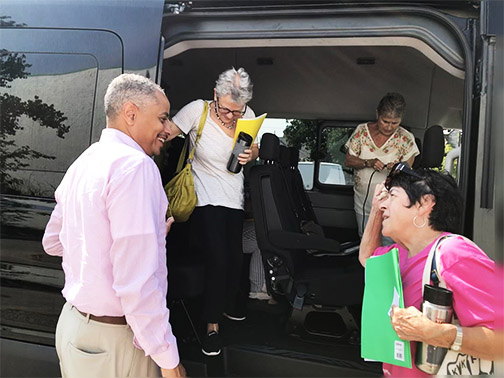
In September, CBKC President & CEO Emmet Pierson, Jr., was, as Cheryl Barnes, president of Blue Hills Neighborhood Association, said, “… riding around town in a van full of women old enough to be his mother.” In fact, he was touring the city with Ms. Barnes and her colleagues who were learning about projects awarded tax increment financing.
Barnes also is on the board of the League of Women Voters of Kansas City/Jackson/Clay/Cass/Platte counties, and it is in that capacity that she invited Pierson to provide a developer’s perspective on where tax incentive programs are used in Kansas City. Pierson gave a guided tour during a joint session with the League and the Junior League of Kansas City.
“The League of Women Voters of Kansas City is doing a study on how TIF (tax increment financing) and other tax abatement programs are used in Kansas City,” said Barnes. “The committee has had a number of speakers in and we thought it would be beneficial to see how Kansas City tax dollars are being used to support development. We rented a van, got a small speaker system and went cruising through downtown with Emmet pointing out various projects. It was fascinating.”
Barnes explained that the League must conduct a fairly comprehensive study – on any subject – bring back impartial findings to the membership and develop a consensus. Once the League has consensus on a topic, then it can lobby to affect change. Like the rest of the city, members of the League were curious about the tax breaks, but didn’t have a position on them, hence the need for a study.
Pierson said the tour was an example of CBKC living out its mission of connecting, to the community and connecting members of the community to one another. Engaging in this way allows CBKC to listen, share its knowledge and fill communication gaps where appropriate.