Latest News

CBKC Partner MO Hives KC Creating Buzz, Named Missouri Beekeeper of the Year
Community Builders of Kanas City partner MO Hives KC has been busy as, well, a bee. Enjoying huge growth since its inception in 2019, the organization’s co-founder Dr. Marion Pierson was named 2021 Beekeeper of the Year by the Missouri State Beekeepers Association in October. The nonprofit organization has been hard at work placing honeybee farms on blighted urban properties in order to pollinate nearby food gardens, providing fun and educational programs to the community and driving economic opportunities.
“I’m floored that I was chosen as Missouri’s beekeeper of the year,” said Dr. Pierson. “I think the Missouri State Beekeepers Association liked the innovative approaches we, as an organization, are taking, not just in terms of the urban locations of our hives, but also the infrared cameras and mobile app technology we are using to monitor the health and productivity of our hives.”
Over the past year, the organization has grown from a single bee farm on six vacant and blighted lots secured through a low-cost lease from CBKC at Wabash and 50th St., to five locations with an all-volunteer staff of 12. The new hive installations can be found at Blue Hills orchard, 4812 Park Ave.; Children’s Mercy Hospital Community Garden at 22nd and Gillham Rd.; Hope Faith Ministries community garden, 705 Virginia Ave.; and atop the vacant Adam’s Mark Hotel building at 9103 E 39th St. In addition, the Hope Faith Homeless assistance campus hives are set to begin next spring.
“Our footprint keeps expanding,” says Dr. Pierson. “We are eager for more volunteers and donors who want to support what we are doing.”
Dr. Pierson enjoys educating the public about the importance of honeybees to the food supply.
“Everybody needs to know that bees and pollinators are a necessary part of the food chain,” she said. “Since 80 percent of the world’s plants are pollinated by bees, including 90 food crops, having a healthy food supply starts with having healthy bees.”
Ensuring the proliferation of healthy bees is important to the economy as well. According to the U.S. Department of Agriculture, honeybee colonies contribute $15 billion to the economy annually, but the dwindling honeybee population – almost halved since the 1940s – is a threat.
To educate the community about the importance of beekeeping, MO Hives KC has created a variety of programs, partnerships and volunteer opportunities. One vehicle for education is its summer green jobs workforce development program. The Missouri Department of Conservation (MDC) partnered with Heartland Conservation Alliance and nearly a dozen other community partners to develop the program. MDC funded eight MO Hives KC beekeeping/ apiary stewards who interacted virtually and onsite with speakers from around the country. Seven students fully completed the internship, and they were offered seasonal honey harvesting jobs with a local honey supplier.
In addition, MO Hives KC participates in educational talks and hosts events like its harvest celebration in September that offered honey tastings from Missouri beekeepers and food samplings from area gardens.
The MO Hives KC organization invites all Kansas Citians to join the bee movement. Volunteers are needed year-round to help with activities like feeding the bees and maintaining the apiary sites. To get involved or learn more visit MOHives.org. To see news coverage about MO Hives KC visit KSHB.
Affordable Housing in Crisis
By Emmet Pierson, Jr.
The coronavirus pandemic exposed extreme disparities in housing options and availability for our working class and disadvantaged populations. In many neighborhoods across the country, lack of access to quality housing is an unofficial “state of emergency” with no clear direction of how to address the problem.
Good housing options are not available at a price point that an increasing number of individuals and families can afford while having enough money remaining to meet their basic needs or create savings. A a majority of these households live paycheck-to-paycheck and are just one setback or unexpected expense away from being unable to pay their rent or mortgage.
A Joint Center for Housing Studies of Harvard University, “America’s Rental Housing 2020,” reports that one in four renters spent more than half of their incomes on housing in 2018.1
To meet the 30-percent-of-income affordability standard, a household earning $30,000 a year would have to pay no more than $750 a month for housing costs, while a household earning $45,000 would have to pay no more than $1,125. As the stock of units charging such low rents continues to decline, it is increasingly difficult for households with modest incomes to find housing that is within their means. JCHS of Harvard University, America’s Rental Housing 2020
Millions more live in a state of housing uncertainty, described as living with a friend or family member, experiencing frequent moves, having trouble paying rent or being without consistent employment. A full-time Kansas City-area employee making Missouri’s 2021 minimum-wage of $10.30 per hour does not have a high enough income to afford a market-priced, two-bedroom home in any county of the metro.
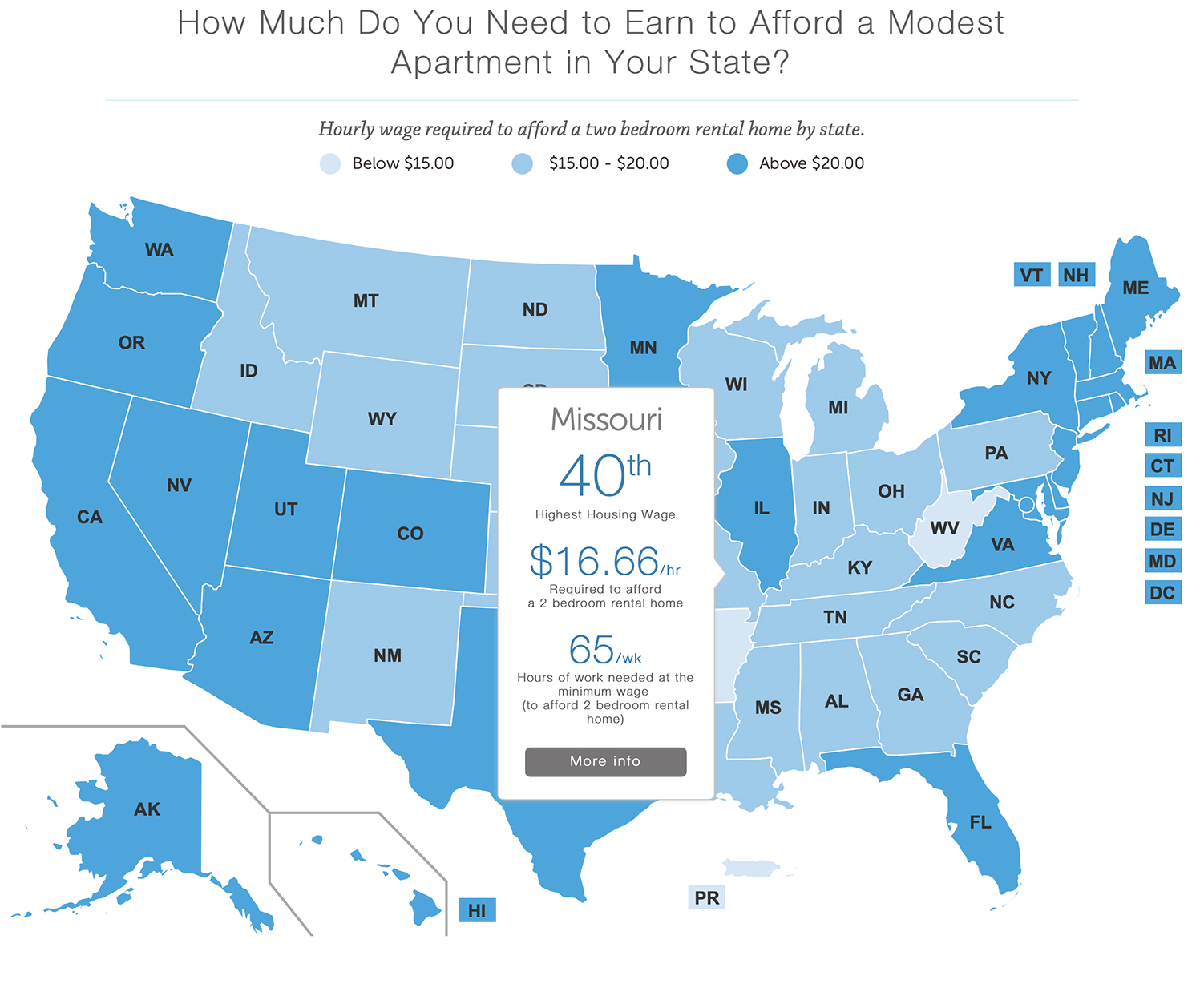
That is according to the National Low Income Housing Coalition’s “Out of Reach: The High Cost of Housing 2021” report issued in July that shows the hourly wage would have to be $16.66 per hour to afford a two-bedroom rental home or, the employee would have to work a 65-hour work week at the current minimum wage to afford the same home.2
National Low Income Housing Coalition, Out of Reach: The High Cost of Housing 2021
While solutions at the federal level go wanting, some progress has been made locally to address the challenge of access to quality housing for Kansas City-area, lower- and middle-income individuals and families.
In 2017, Kansas City, Missouri, voters passed the Central City Economic Development (CCED) sales tax, which imposes a 1/8th percent sales tax to fund economic development projects in Kansas City’s urban core, which has experienced disinvestment and redlining for decades. In each of its annual rounds of funding, CCED-derived revenue has spurred the rehabilitation or addition of affordable housing choice in our urban residential neighborhoods including single-family and cottage-style homes, apartments, townhomes, assisted living, senior living and homes accommodating the disabled.
Within CBKC there has always been a strong focus on quality, affordable housing. Since our beginning in 1991, we have leveraged our role as a strong, stable and experienced community development corporation to add more than 750 housing units, primarily apartments and townhomes, either through complete renovation of substandard housing or new construction.
Community Builders’ $225 million investment in urban renewal over the years has earned recognition and respect on the national community development stage. We take seriously our responsibility in economic development access and advocacy for Kansas City’s east side and see that there is no better time than now to partner-up and scale-up.
1 Joint Center for Housing Studies of Harvard University https://www.jchs.harvard.edu/americas-rental-housing-2020
2 NLIHC Out of Reach 2021: Missouri https://reports.nlihc.org/oor/missouri

CBKC Campus Sees $40+ Million in New Development
Over 30 years, since its 1991 founding, Community Builders of Kansas City completed $250 million in development in neighborhoods throughout the East Side. In the last two and a half years, since 2019, CBKC has participated in more than $40 million in new investment on its Dr. Martin Luther King Jr. Boulevard headquarters campus alone.
Blue Parkway Sun Fresh: $1 million
Swope Health’s PACE KC: $15 million
The Cleveland: $13 million
The Rochester: $13 million
Specialty health services: $1 million
“Private money has not come running to the East Side and when your capital stack depends on incentives and public money, development can take a long time,” said Emmet Pierson, Jr., CBKC’s president and CEO. “In response, CBKC has leveraged our team’s knowledge and experience on how to move things forward to help accelerate our projects.”
The CBKC team has grown from four to 11 in the last two-plus years and includes long-time industry leaders in finance, development, government relations, legal, asset management, architecture, community engagement and store management.
Pierson said CBKC’s new way of doing business is a mix of thoughtfully cultivated strategies – building trust with elected officials and others, being open to partnerships, taking its models that have succeeded into new footprints as well as investing the organization’s own equity in a deal without taking a development fee.
“Some projects are just so important to us, like The Rochester, that we invested the resources of our nonprofit organization to make sure it’s done now, and right,” Pierson added. “The Rochester brings a residential option to this corridor that does not presently exist.” Named after R. (Rochester) Charles (Chuck) Gatson, the visionary founder of CBKC, it is the first market-rate, multi-family development east of Prospect in generations. The 64 residential units across four stories will feature in-demand finishes and amenities for the one-bedroom/one bath, one-bedroom plus den/one bath and two-bedroom/two-bathroom units.
While CBKC owns 700 units of affordable housing, the minority-led organization determined the biggest need of its community was access to quality goods and services. The organization owns and manages more than 300,000 square feet of office/retail and has another 60,000 square feet in development.
“Our walkable headquarters campus is becoming a destination for CBKC’s community to accomplish many of their routine needs – banking, health care, food – and to take care of a lot of other services,” said Shannon Hesterberg, CBKC’s chief operations and real estate officer. “There is more coming including amenities such as campus WiFi and others we are now looking into like charging stations and bike/scooter rental services.”
The organization’s 69,000-sq.ft. headquarters building at 4101 Dr. Martin Luther King Boulevard has consistently maintained 100 percent occupancy for the last several years, nearly 15 points above Kansas City, Missouri’s commercial real estate average. The building has a curated roster of like-minded organizations dedicated to serving the urban core.
About the projects underway on the campus:
Blue Parkway Sun Fresh
- This full-service grocery store now owned and operated by minority-led CBKC, came into the organization’s portfolio as part of the nonprofit’s commitment to changing the urban landscape not just physically but to impact quality of health as well.
- Acquired a year ago, CBKC has introduced quality product and pricing competitive with suburban store offerings, launched online shopping, in-store banking services, made physical improvements and has a vision for amenities such as a coffee shop/bar and community kitchen.
- Jobs can grow into career of several chosen paths such as IT, management, product representation and more.
- Revenues have grown 25 percent in the years since CBKC acquired the store.
PACE KC
- CBKC sold Swope Health the land for its healthcare program that provides a continuum of care and services to individuals aged 55 and older.
- The planned two-story, 32,000-sq.ft. PACE, or Program of All-Inclusive Care for the Elderly, facility will be located adjacent to Swope Health Central at 4141 Dr. Martin Luther King Jr. Boulevard.
- It is anticipated it will break ground in late 2021 or early 2022 and include 90, high-quality jobs.
The Cleveland
- This $12.6 million rehabilitation project will transition the 70 duplexes and 10 townhomes from fully affordable to mixed income and will complete by yearend 2022.
- The advantage of the mixed income status is that if residents’ income grows they can stay in the community. In fully affordable properties, a resident has to move if he or she makes too much money.
- These family properties all feature three-bedroom, one- and one-half bath units from 1,039 to 1,276 square feet with an attached garage.
- In addition to the extensive exterior and interior renovations and upgrades, a new 3,400-sq.-ft. $526,000 community building will go up to house property management staff, a maintenance shop as well as a space for classes, a computer room, exercise and flex area.
The Rochester
- The 81,400-sq.-ft, $12.6 million project broke ground in April 2021 and is expected to complete in 2022.
- The 64 residential units across four stories will have competitive rates for the one-bedroom, one bath; one-bedroom plus den, one bath; two-bedroom, two-bath units as well as a penthouse two-bedroom executive suite.
- Amenities include stainless steel appliances, solid-surface countertops, in-unit washer and dryer, an indoor/outdoor rooftop deck, fitness center, package pickup room, community meeting space as well as landscaped front and back yard spaces for grilling and gathering around the fire pit.
Specialty health services provider
- CBKC attracted a specialty health services provider who is completing a $1 million build-out of space which will announce its new location and services when it takes occupancy, which is expected sometime in the fourth quarter of 2021.

CBKC Campus Open-access Wi-Fi to Help Address Digital Divide
Community Builders of Kansas City is in its final phase of development to install public access 1-2 gig Wi-Fi on its Dr. Martin Luther King Jr. Boulevard headquarters campus. The $125,000 project is an advocacy investment by the minority-led nonprofit organization to help address the urban core’s digital divide. It is expected to be live in the first quarter of 2022.
Kim Cronan, senior property manager with Colliers who is coordinating the project for CBKC, said the Wi-Fi service will be open network with signal strength from the west end of the 4001 CBKC headquarters building (and The Rochester once completed) to the retail center on the east. Community members in their cars, campus common areas or outside office, retail and grocery areas will be able to access the digital service. Unite Private Networks is the service provider.
“The digital divide is another serious disadvantage members of our community face daily,” said Emmet Pierson, Jr., CBKC president and CEO. “For many, they have nowhere to go for free Wi-Fi. CBKC is investing in this Wi-Fi installation to provide an immediate, practical response to this critical access issue.”
Cronan added that the project includes installation of some exterior seating areas for use by campus employees, customers or guests.
According to Digital Inclusion KC:
- Many employers require online job applications.
- Social Security information is moving to online-only access.
- Accessing the Health Insurance Marketplace requires a device and an Internet connection.
- Schools increasingly rely on electronic tools to educate our children.
- The Internet keeps people connected to their friends and family.
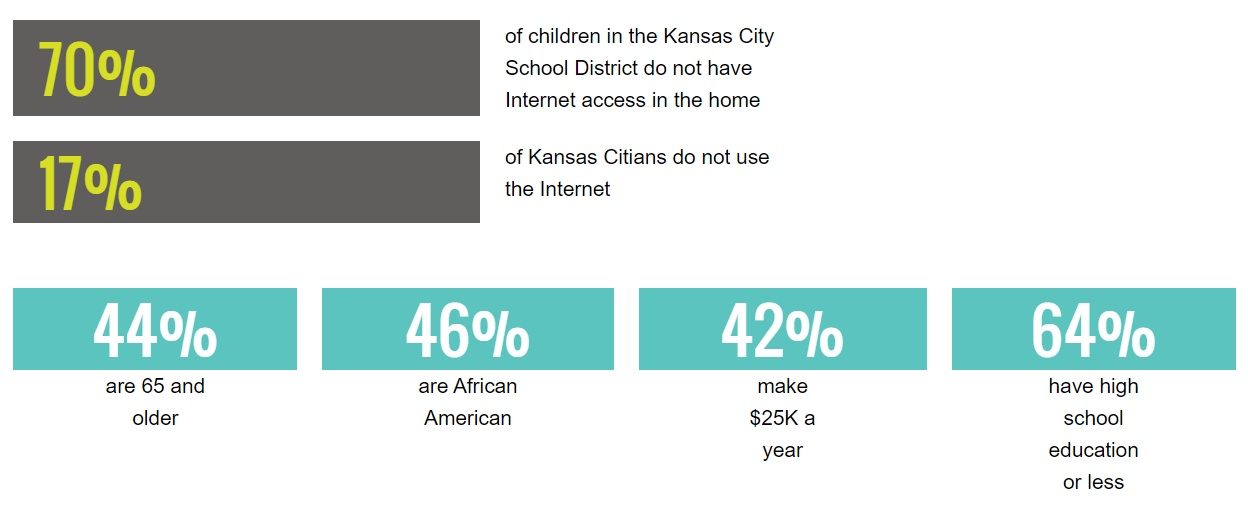
Source: Digital Inclusion KC, https://digitalinclusionkc.org/the-problem
CBKC Looks Ahead to the Future with Strategic Planning Session
In 2019, Community Builders of Kansas City retained Steve Glaude, president of strategies based in Washington, D.C., to facilitate development of a three-year strategic plan for the organization. Its goals had measurable outcomes and timelines and addressed capacity, its business model, financial stability, empowering families and communities and communications.
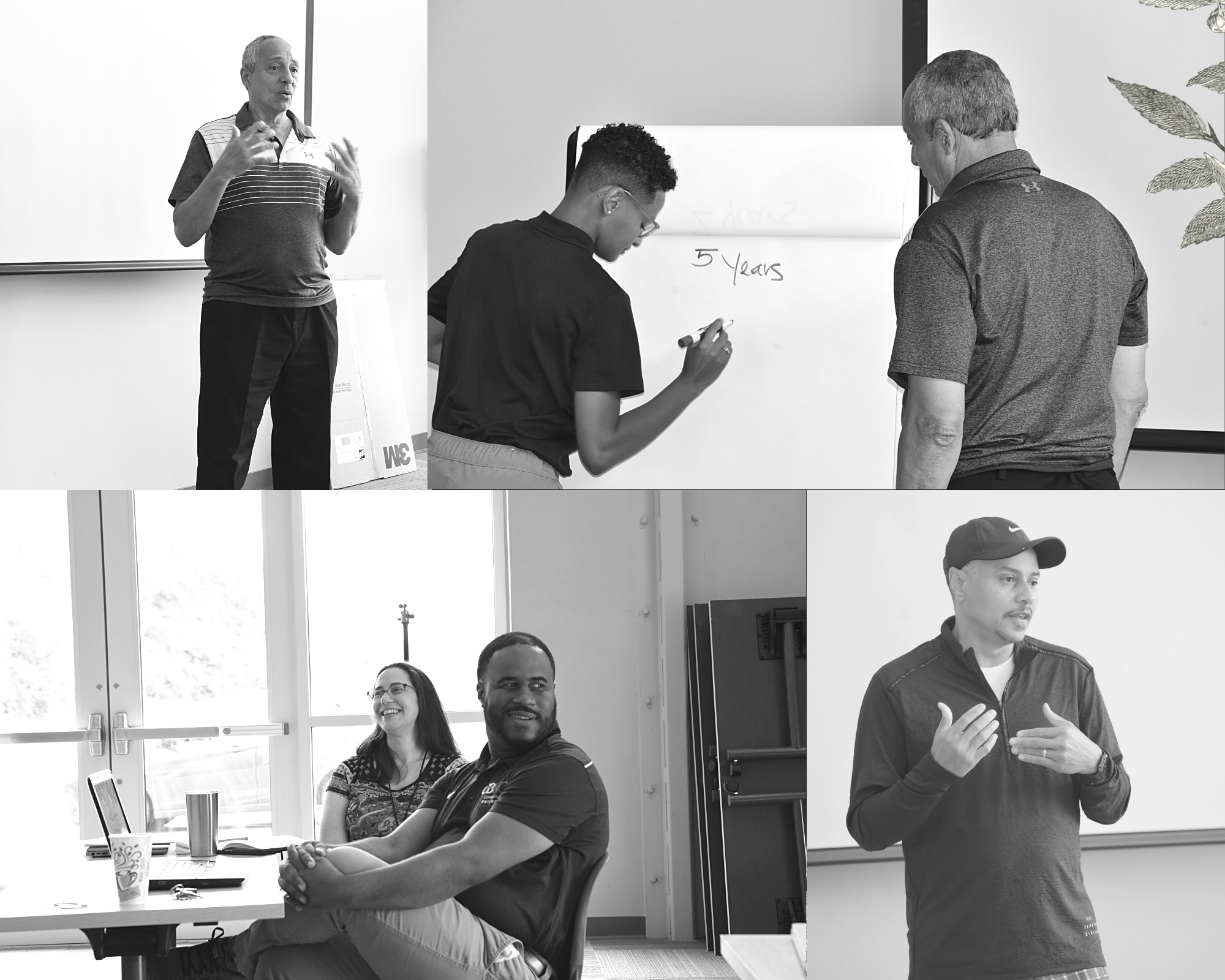
In August 2021, Glaude returned to facilitate a review of work to date and a discussion of what is next. Glaude’s report from the session states that in the last two years, “… most of the goals had been completed or significantly advanced and that the goals should be expanded.” Work now is underway within CBKC to set benchmarks for the next two, five and 15 years.
Since Emmet Pierson Jr., CBKC’s president and CEO, was recruited to helm the organization in June 2019, professional staff has grown from four to 11. The team represents deep and diverse experience and backgrounds and each has clearly defined roles. This team advanced the setting of clear organizational objectives and aligned them with the right focus and resources so they could execute on well-established plans regardless of any long-standing or emerging barriers.
“There is a culture of persistence in the organization to keep on,” said Shannon Hesterberg, CBKC chief operations and real estate officer. “Despite the pandemic, despite systemic inequities, despite whatever the obstacles are, we press forward.”
That persistence led CBKC to purchase and improve one of the only full-service grocery stores in the urban core, develop a new housing choice with the market-rate multi-family property The Rochester, develop the mixed-used Offices at Overlook on 11 acres along Dr. Martin Luther King Jr. Boulevard, bring more healthcare services to its headquarters campus, plan the launch of community Wi-Fi and more. Now the organization is pursuing, and is being pursued to do, other initiatives.
“CBKC has invitations from other communities to consult, participate in or lead projects,” said Pierson. “Our mission to change the urban landscape is not confined to real estate development. Our mission clearly states it is by fueling equity, access, opportunity and advocacy. As far as our strategic plan goes, the goals were always broad.”
The organization now is in discussion or actively engaged in projects ranging from multi-use developments outside of the Kansas City metropolitan area, beautification of and safe pedestrian crossings along Dr. Martin Luther King Jr. Boulevard, new commercial and industrial initiatives, as well as greater housing, health, career and cultural access and choice for its community.
“The Kauffman Foundation made a $2.7 million project investment more than 20 years ago, which spurred over $225 million of additional reinvestment along the Brush Creek Corridor,” Pierson said. “We’ve added another $40 million plus to that portfolio in just the last two years. We have learned how to accelerate the pace. Every day we’re adding to our track record as a leading, credible community developer.”
Five Ways CBKC is Building Healthy Communities
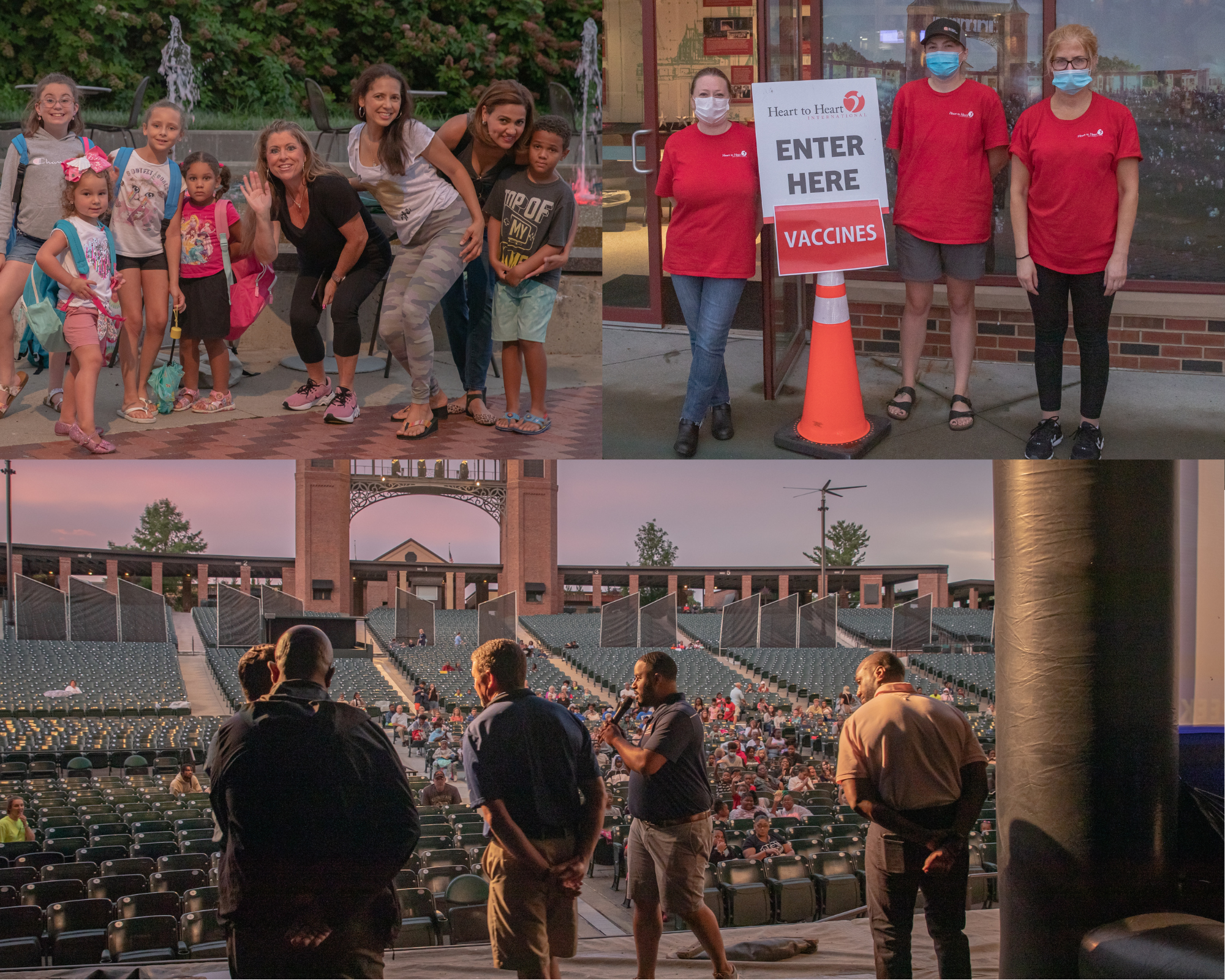
One of Community Builders of Kansas City’s strategic objectives is to empower families and communities. To that end, CBKC, through grants and partnerships with other charitable organizations, is engaging in initiatives, beyond brick and mortar development, that offer the community resources, programs and services that enhance mind, body and spirit. Here are the top five programs:
1. Vaccinating more than 17,000 residents in three months
On March 31 CBKC hosted its first vaccination event, a drive-thru with free food and diapers at the Kansas City Zoo. Kansas City Chiefs wide receiver Tyreek Hill helped workers from Harvesters and volunteers distribute food. Event co-sponsor Rep. Emanuel Cleaver II and Jackson County Executive Frank White turned out to lend support as well. CBKC also hosted vaccination events at various community churches on April 10 and 17 and May 8 and 22. In addition, vaccinations were offered at the May 29-30 grand reopening of Blue Parkway Sun Fresh. More than 17,000 individuals were vaccinated from March to May, resulting in a healthier, safer community. Finally, CBKC provided a retail venue for Swope Health Services to host a Covid-19 vaccine clinic at The Shops on Blue Parkway from February through July 2021.
2. Providing free food, diapers, backpacks, healthcare products, books, computers and more
In August, CBKC participated in a back-to-school rally that provided about 2,300 free backpacks, over 18,000 pounds of food, 500 healthcare packs, hundreds of books, over 50 tablets and computers, over 9,000 feminine products, 66 COVID-19 vaccines and more. Over the past year CBKC has participated in 10 events that provided basic necessities to the community.
3. Providing free WiFi in its office building and parking lot for community use
CBKC will offer free WiFi for community use in its 4001 Dr. Martin Luther King, Jr. Blvd. building and parking lot. Read more about this exciting endeavor in the Advocacy section of this blog.
4. Transforming inner city lots from vacant to vibrant
Local not-for-profit MO Hives created Kanas City’s first urban bee farm on land CBKC owns along Wabash Avenue. The apiary provides an opportunity to educate residents young and old about the necessity of bees and other pollinators to grow produce, beautify once blighted lots and spur interest in science among young students.
5. Hosting a family movie night and symphony performances
Along with physical health, CBKC strives to enhance the spirit of the community by offering free entertainment. The past two summers, a free family movie night was held at Starlight. In June 2021, members of the Kansas City Symphony performed in the CBKC office parking lot and another performance is coming October 9.